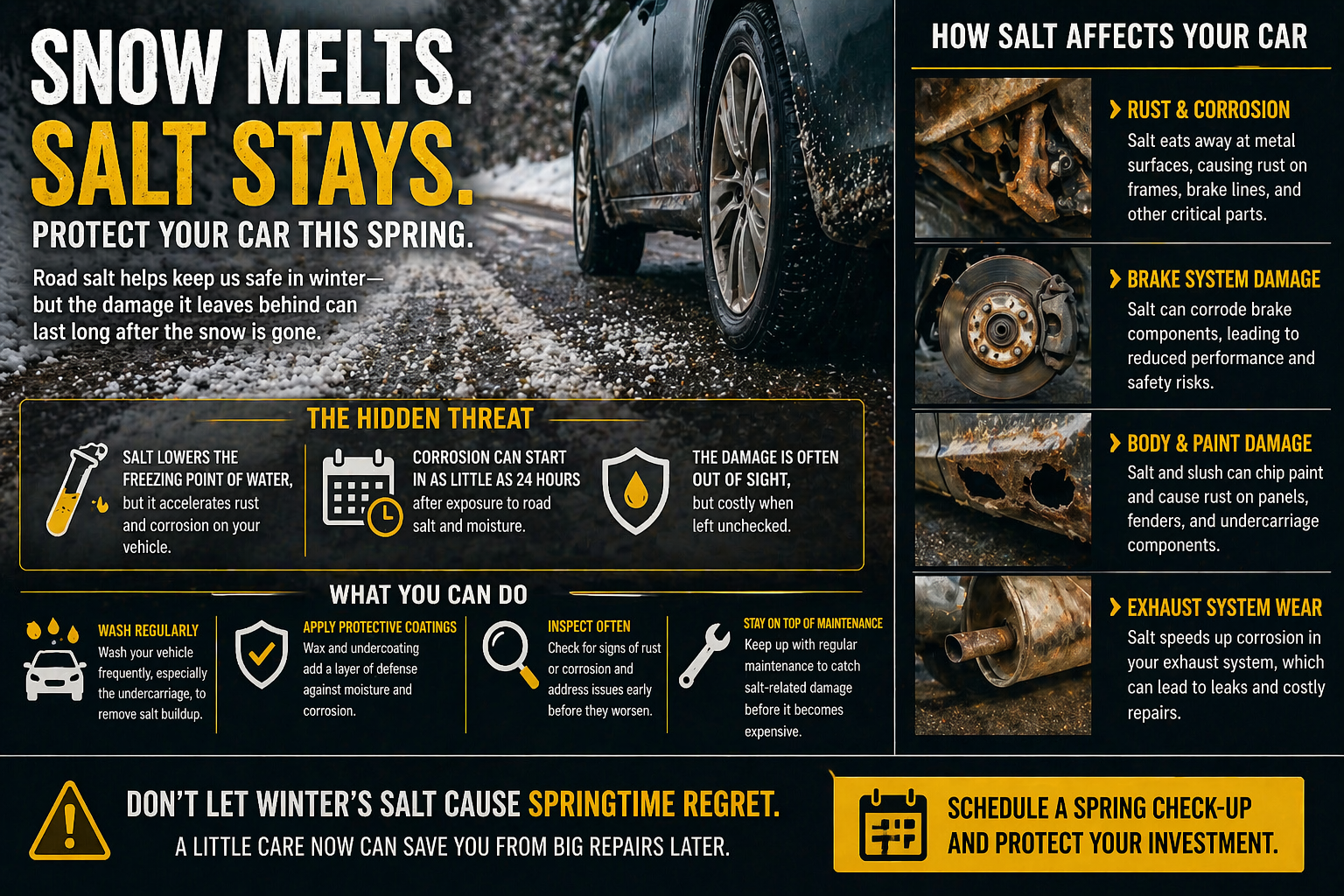
Road salt is a necessary evil in New Jersey winters. It keeps you from sliding through intersections on Route 21 and keeps the plows moving on the Parkway. Nobody's arguing against it. But once the temperatures climb and the last of the slush dries up, that salt doesn't just disappear. It soaks into every crevice underneath your car — and your brake system takes the worst of it.
We've been in this business since 1994. Every spring, repair shops see the same pattern: people come in for something routine — an oil change, a tire rotation — and find out their brakes were a lot worse off than they thought. The salt is quiet. It doesn't announce itself with a warning light. It just does its work, month after month, until the problem becomes unavoidable.
Know This Before You Drive This Spring
Sodium chloride (road salt) becomes particularly corrosive when wet. After a winter season on New Jersey roads, the average vehicle's brake hardware has been exposed to dozens of wet-dry salt cycles — each one accelerating rust, seizure, and wear.
What Salt Actually Does to Your Brakes
It's worth understanding what you're dealing with, because "my car is rusty" doesn't quite capture it. Salt corrosion isn't just cosmetic — it degrades the mechanical function of multiple brake components at once.
01
Brake Bind on Rotors & PadsRust forms between the pad and rotor surface during cold, damp storage. When you first apply the brakes after a freeze, you feel it — a slight shudder or groan. That's corrosion breaking loose. If the pads can't release cleanly, you get uneven wear, reduced stopping power, and heat buildup over time.
02
Caliper SeizureCaliper slider pins are supposed to move freely so the pad engages evenly. Salt corrodes those pins, and a seized caliper applies braking force constantly — even when you're not touching the pedal. The result: one side wears faster, you lose fuel economy, and eventually the caliper itself fails.
03
Brake Line CorrosionSteel brake lines are vulnerable to salt pitting. Surface rust alone isn't an emergency, but deep corrosion can compromise line integrity. This is the one we take seriously. A line failure is a brake failure — full stop.
04
Rotor Surface DeteriorationA winter's worth of salt-wet braking creates micro-pitting on rotor surfaces. Pitted rotors don't contact brake pads evenly, which means you're not stopping as efficiently as you should be — even if everything feels "fine" on your daily commute.
The Spring Inspection Checklist
Use this as a discussion list for a qualified technician. The vehicle manufacturer’s procedures and specifications, professional testing and the actual condition of the vehicle determine any repair.
- Rotor condition and brake-pad wear against the vehicle specification.
- Calipers, slider hardware and related components.
- Brake lines, hoses and fittings.
- The required brake fluid specification and service history.
- Parking-brake operation.
Brake Parts to Ask About
Washington Auto Parts' storefront is at 32 Greenwood Ave, East Orange. Newark warehouse pickup at 15 Victoria St is available for stocked items during warehouse hours — call first. City Line Auto Repair at 741 Springfield Ave, Irvington, is our repair-service partner station; see the Irvington guide for its hours and station-specific delivery service. For other Irvington addresses, call to confirm the arrangement. Whether you're a shop owner, fleet manager, or DIYer, call 973-672-2260 to confirm brake-part availability, fitment, pickup or delivery options, and timing.
Brake Service Parts Checklist
Brake Pads
Economy, OE-match, and performance ceramic. Ask the team to confirm fitment and availability for your vehicle.
Rotors
Standard and drilled/slotted for passenger cars, trucks, and SUVs. Ask about pricing for the quantity needed.
Caliper Hardware Kits
Slider pins, boots, and grease — the parts most shops skip but shouldn't.
Brake Fluid
Use the vehicle manufacturer’s required brake-fluid specification. Ask the counter about the exact product and current options for the job.
Brake Line & Fittings
Pre-bent sections and bulk roll. Copper-nickel line available for corrosion resistance.
Brake Cleaner
Non-chlorinated for daily shop use. Removes salt residue, grease, and brake dust fast.
Share your vehicle and brake-part details with the counter team. Call 973-672-2260 to check suitable options and current availability before arranging pickup or delivery.
The Fast Lane Gets It to Your Shop
If you're running a repair shop in the area, you already know how a slow parts run can bottleneck an entire day. Our commercial delivery service — The Fast Lane — supports repair shops from our East Orange store. Call 973-672-2260 to confirm availability, delivery options, estimated timing, and any fee for your order and address. Ask the team about commercial-account options and applicable terms.
Spring brake season is exactly when turnaround speed matters. Cars come in needing rotors and pads; your customer's waiting; you need parts fast, not eventually. That's the gap we close. Open a commercial account with us and we'll handle the rest.
Don't Wait for the Squeak
Noise, vibration or changes in braking are reasons to seek a qualified technician’s assessment. Do not identify the failed component from a sound alone.
Discuss brake inspection findings with a qualified technician and identify the specific component needed before ordering. Repair costs depend on the actual vehicle, parts and work required.
Come in, ask questions, and let us help you figure out what your vehicle actually needs. That's what we're here for — and we've been doing it in this community for over 30 years.
Original publication
This website edition is based on the Washington Auto Parts article by Miguel Suarez in Inside the Fast Lane. The original published copy is preserved; this edition removes unverified timing/cost examples and presents inspection topics for professional assessment.
All news and auto-care articles · Parts categoriesFluids catalog · Contact the counter